Fatigue après les fêtes : comprendre le manque d’énergie et relancer sa vitalité
En janvier, nous sommes nombreux à nous sentir épuisés, lessivés, sans énergie. Y’a-t-il vraiment une relation entre la période hivernale et le manque d’énergie ? Quelles sont les raisons d’un tel ressenti ? Le Blue Monday est-il un mythe marketing ou y a-t-il une vraie baisse de moral en hiver ?
Pourquoi on se sent plus fatigué en hiver (et surtout après les fêtes)
Spoiler alert : La fatigue hivernale n’est pas “dans la tête” : elle repose sur plusieurs mécanismes bien documentés
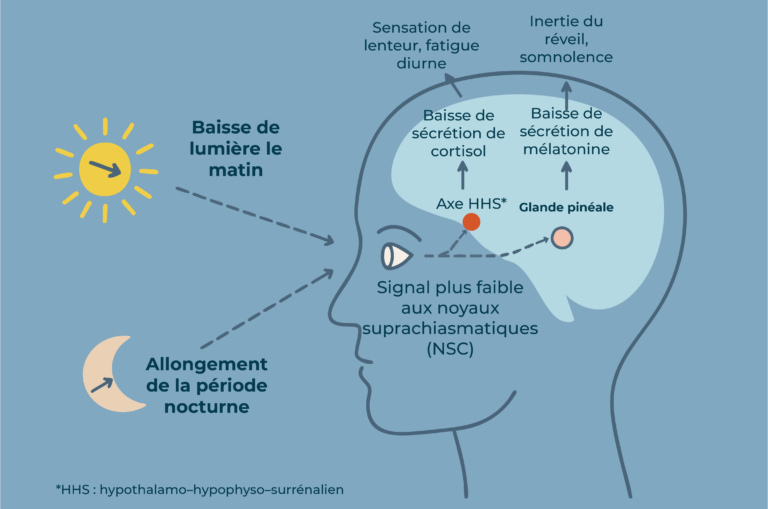
1) Moins de lumière = horloge biologique perturbée
En hiver, l’exposition à la lumière naturelle baisse. Or, la lumière est un signal majeur pour synchroniser le rythme circadien (veille/sommeil). Quand ce signal manque, certaines personnes voient leur sommeil se décaler (endormissement plus tardif, réveil difficile) et ressentent davantage de somnolence et de baisse d’énergie. Cette logique est au cœur des explications biologiques de la dépression saisonnière et des “coups de mou” hivernaux.
2) Sommeil moins réparateur (et “dette de sommeil” post-fêtes)
Les fêtes de fin d’année cumulent souvent : couchers tardifs, réveils plus tôt, déplacements, écrans, repas lourds… Résultat fréquent : dette de sommeil + “jet lag social” (décalage entre rythme semaine/week-end), tous deux associés à une dérégulation circadienne et à un impact sur l’immunité et la récupération.
3) Alcool ≠ sommeil de qualité
L’alcool peut donner l’impression d’aider à s’endormir, mais il modifie l’architecture du sommeil et tend à dégrader la qualité de la seconde partie de nuit (fragmentation, sommeil moins réparateur). Le lendemain, fatigue, “brouillard” mental et baisse de motivation sont classiques.
4) Repas riches : inflammation postprandiale et coup de barre
Les repas très gras et/ou très sucrés peuvent déclencher une réponse postprandiale défavorable (stress oxydatif, marqueurs inflammatoires, baisse transitoire de la fonction endothéliale), ce qui peut contribuer à la sensation de lourdeur et d’une baisse d’énergie — surtout quand cela se répète sur plusieurs jours comme lors des fêtes de fin d’année.
“Blue Monday” : mythe ou réalité ?
1. L’origine : une opération de communication, pas une découverte scientifique
“Blue Monday” est généralement présenté comme “le jour le plus déprimant de l’année” (souvent le 3e lundi de janvier, soit le 19 janvier pour l’année 2026). Mais l’idée vient d’une campagne marketing associée à une formule largement critiquée comme non scientifique.
2. Ce qu’on peut dire honnêtement
- Non, la science ne valide pas l’existence d’un “jour le plus déprimant” universel calculable par une équation.
- Oui, janvier peut être difficile pour beaucoup de gens, mais pour des raisons banales et variables : manque de repos durant les fêtes, reprise du travail, météo maussade, faible lumière, dette de sommeil, contraintes financières, objectifs irréalistes, etc.
Nos conseils pour être plus en forme en hiver
1) Soigner son sommeil (priorité n°1 contre la fatigue)
Le manque ou la mauvaise qualité de sommeil est l’une des premières causes de fatigue.
Les autorités de santé recommandent :
des horaires de coucher et de lever réguliers,
d’éviter alcool et excitants le soir,
de dormir suffisamment selon ses besoins.
2) S’exposer à la lumière naturelle chaque jour
La lumière du jour est essentielle pour réguler l’horloge biologique (rythme veille/sommeil).
En hiver, le manque de luminosité peut accentuer la somnolence et la baisse d’énergie.
Même par temps gris, sortir quotidiennement aide à mieux se réveiller et à améliorer la vigilance.
3) Bouger régulièrement, même modérément
L’activité physique régulière aide à :
réduire la fatigue,
améliorer la qualité du sommeil,
maintenir l’énergie au quotidien.
Il n’est pas nécessaire de pratiquer un sport intensif : la marche quotidienne et la réduction du temps passé assis sont déjà bénéfiques.
4) Adopter une alimentation équilibrée et s’hydrater
Une alimentation variée et des repas réguliers contribuent à limiter les coups de fatigue.
La déshydratation, même légère, peut aussi accentuer la sensation de lassitude.
Nos conseils PharmaSmile pour relancer sa vitalité en hiver
Dans le cadre de la fatigue hivernale après les fêtes, certains compléments alimentaires PharmaSmile peuvent être intégrés dans votre routine afin de
formule associant vitamine C, vitamine D3, zinc et extrait d’échinacée pour contribuer au fonctionnement normal du système immunitaire et à la réduction de la fatigue.
notre vitamine C utilise une technologie d’encapsulation liposomale qui contribue à la stabilité de la vitamine dans la formulation antioxydante contribuant à protéger les cellules contre le stress oxydatif et à la réduction de la fatigue.
une association de multi-vitamines et minéraux essentiels, ce complément alimentaire est conçu pour soutenir l’apport nutritionnel et contribue à réduire la fatigue.
une association de magnésium chélaté, taurine et vitamine B6 qui contribuent à réduire la fatigue et au fonctionnement normal du système nerveux.
Ces compléments alimentaires s’intègrent dans une hygiène de vie saine et ne doivent pas remplacer un traitement médical ou une alimentation équilibrée.
Conclusion
La fatigue hivernale après les fêtes n’est pas une fatalité : elle s’explique par des mécanismes bien identifiés comme le manque de lumière, la dette de sommeil, les excès alimentaires et la reprise d’un rythme soutenu. Même si le mois de janvier peut être plus éprouvant physiquement et mentalement, le fameux « Blue Monday » n’a en réalité pas de fondement scientifique.
Pour retrouver de l’énergie en hiver, les piliers restent : un sommeil de qualité, une exposition quotidienne à la lumière naturelle, une activité physique régulière et une alimentation équilibrée avec une bonne hydratation.
En complément de ces bases, certains de nos compléments alimentaire PharmaSmile peuvent accompagner cette période en apportant des nutriments utiles au fonctionnement normal de l’organisme et à la réduction de la fatigue.
Sources et références
Hannah K. Dollish, Mariya Tsyglakova, Colleen A. McClung, Circadian rhythms and mood disorders: Time to see the light, Neuron, Volume 112, Issue 1, 2024. https://www.sciencedirect.com/science/article/pii/S0896627323007109
Faraut B, et al. Immune disruptions and night shift work in hospital healthcare professionals: The intricate effects of social jet-lag and sleep debt. Front Immunol. 2022 https://pmc.ncbi.nlm.nih.gov/articles/PMC9509137/
Katie S McCullar, Altered sleep architecture following consecutive nights of presleep alcohol, Sleep, 2024 https://pubmed.ncbi.nlm.nih.gov/38205895/
Ian M Colrain, et al. Alcohol and the Sleeping Brain, Handb Clin Neurol, 2018 https://pmc.ncbi.nlm.nih.gov/articles/PMC5821259/
Mazidi et al. (2021), Meal-induced inflammation: postprandial insights from the Personalised REsponses to DIetary Composition Trial (PREDICT) study in 1000 participants, ScienceDirect, 2021 https://www.sciencedirect.com/science/article/pii/S0002916522004269
Assurance Maladie – Fatigue : les bons réflexes (ameli.fr)
https://www.ameli.fr/assure/sante/themes/asthenie-fatigue/bons-reflexes-cas-faut-consulter
Ministère de la Santé – Sommeil et rythmes biologiques (sante.gouv.fr)
https://sante.gouv.fr/prevention-en-sante/sante-des-populations/sante-environnementale/article/sommeil
ANSES – Activité physique et santé
https://www.anses.fr/fr/content/activite-physique-et-sante