
Vous l’avez vu sur une boîte de fer ou de magnésium en pharmacie.
Vous avez peut-être même choisi ce produit parce qu’il était marqué « bisglycinate », en pensant que c’est la meilleure forme disponible. C’est souvent vrai. Mais pas toujours. On vous explique tout.
"La forme du minéral" : c'est quoi au juste ?
Quand vous prenez un complément alimentaire, par exemple à base de fer ou de magnésium, votre corps ne reçoit pas le minéral tel quel. Il le reçoit sous une forme chimique précise. Et cette forme va déterminer la quantité de ce minéral que votre organisme va réellement pouvoir utiliser.
C’est ce qu’on appelle la biodisponibilité : la part du minéral que vous avalez qui arrive effectivement là où votre corps en a besoin.
Prenons une image simple. Imaginez que vous envoyiez un colis fragile par la poste. Selon l’emballage que vous utilisez, le colis arrive intact… ou en miettes. Le minéral, c’est pareil. Selon sa « forme d’emballage », il arrive bien absorbé par l’organisme, ou en partie dégradé ou perdu en chemin.
Concrètement, les minéraux existent sous différentes formes :
- Des formes basiques et peu coûteuses comme l’oxyde, le carbonate ou le sulfate. Elles sont très répandues dans les compléments d’entrée de gamme, mais souvent moins bien absorbées, et parfois responsables d’inconforts digestifs.
- Des formes organiques comme le citrate ou le malate, généralement mieux assimilées.
Et des formes chélatées, dont fait partie le bisglycinate, considérées parmi les formes les plus intéressantes disponibles aujourd’hui.
La chélation, c'est quoi concrètement ?
Le mot « chélation » vient du grec chêlê et signifie littéralement « pince de crabe ». Dans un minéral chélaté, le minéral est entouré et protégé par des molécules qui le tiennent fermement, comme une pince. Cette « protection » lui permet de traverser le système digestif sans se faire piéger ou dégrader en chemin.
L’acidité de l’estomac, les fibres, certains composants du café ou du thé, le calcium d’un autre aliment… Tout cela peut intercepter un minéral « libre » et l’empêcher d’être absorbé correctement.
Un minéral chélaté est plus stable et passe plus facilement ces obstacles. Il arrive plus intact à destination. Et il est généralement mieux toléré, car il irrite moins la muqueuse digestive.
Et le bisglycinate dans tout ça ?
Le bisglycinate, c’est une forme chélatée spécifique, dans laquelle le minéral est lié à deux molécules de glycine, un acide aminé naturellement présent dans le corps humain.
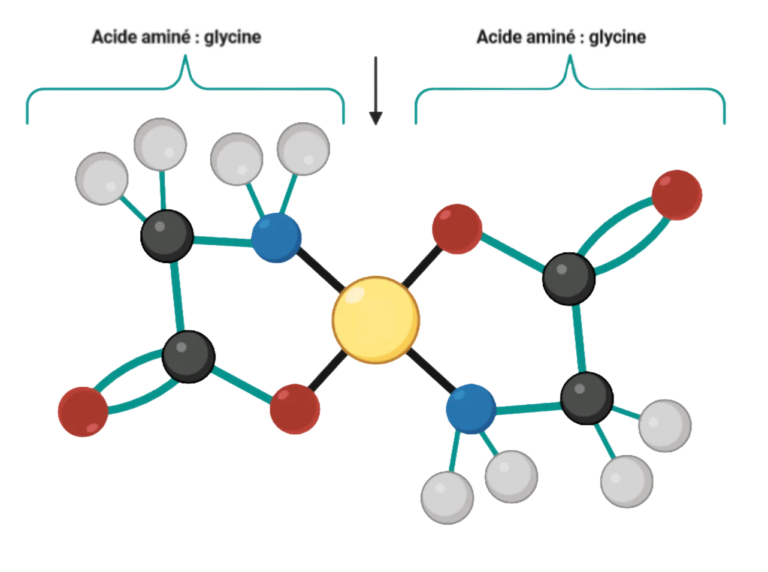
Le bisglycinate, c’est une forme chélatée spécifique, dans laquelle le minéral est lié à deux molécules de glycine, un acide aminé naturellement présent dans le corps humain.
[schéma dawson]
Cette structure particulière rend le complexe à la fois stable et bien reconnu par l’organisme, qui voit passer quelque chose qui ressemble à un acide aminé et l’absorbe plus facilement.
C’est pour ces raisons que le bisglycinate est aujourd’hui considéré comme l’une des formes de référence en micronutrition pour les minéraux, notamment pour le magnésium, zinc, fer.
Attention : "bisglycinate" ne veut pas toujours dire "100 % chélaté"
C’est là que ça se complique…
Afficher « bisglycinate » sur une étiquette ne signifie pas forcément que le produit contient uniquement du bisglycinate chélaté.
Certaines marques utilisent ce qu’on appelle des formes « tamponnées » : en réalité, elles mélangent un peu de bisglycinate avec d’autres formes minérales bien moins intéressantes (comme de l’oxyde ou du carbonate) pour réduire les coûts de fabrication.
Le résultat ? Un produit affiché « bisglycinate » sur la boîte… mais qui ne vous apporte pas les bénéfices d’un vrai bisglycinate chélaté intégral.
Ce n’est pas illégal. Mais ce n’est pas très transparent non plus.
Comment s’en rendre compte ?
Quelques indices qui doivent vous alerter :
- 💶 Un prix anormalement bas pour un produit « bisglycinate »
- 📋 La présence d’oxyde ou de carbonate dans la liste des ingrédients, à côté du bisglycinate
- 🌫️ Des termes vagues comme « complexe de bisglycinate » sans précision sur la teneur réellement chélatée
- ❓ Aucune information la qualité de la matière première
Le choix PharmaSmile : des bisglycinates vraiment chélatés
Chez PharmaSmile, nous avons pris le parti de la transparence et de l’exigence dès la conception de nos formules.
Nos produits contiennent uniquement des bisglycinates intégralement chélatés, pas de formes tamponnées, pas de mélange avec des formes inférieures pour faire baisser le coût.
Néanmoins, grâce au circuit court et à la suppression des coûts superflus, nos produits restent accessibles au plus grand nombre.
Ce choix se retrouve aujourd’hui dans deux de nos formules premium :
💊 Fer bisglycinate PharmaSmile
Un fer sous forme bisglycinate chélaté, associé à la vitamine C pour favoriser son absorption, et aux vitamines B6, B9 et B12 pour soutenir la formation sanguine normale et contribuer à réduire la fatigue.
💊 Magnésium bisglycinate PharmaSmile
Un magnésium sous forme bisglycinate chélaté, une alternative sérieuse à l’oxyde de magnésium, forme très répandue dans les compléments du marché mais reconnue pour sa faible absorption.
Parce qu’en pharmacie, le bon dosage compte. Mais la bonne forme aussi.
Les allégations de santé mentionnées dans cet article sont encadrées par le Règlement (CE) n°432/2012 de la Commission européenne. Un complément alimentaire ne remplace pas un traitement médical. En cas de carence avérée, parlez-en à votre médecin ou à votre pharmacien.